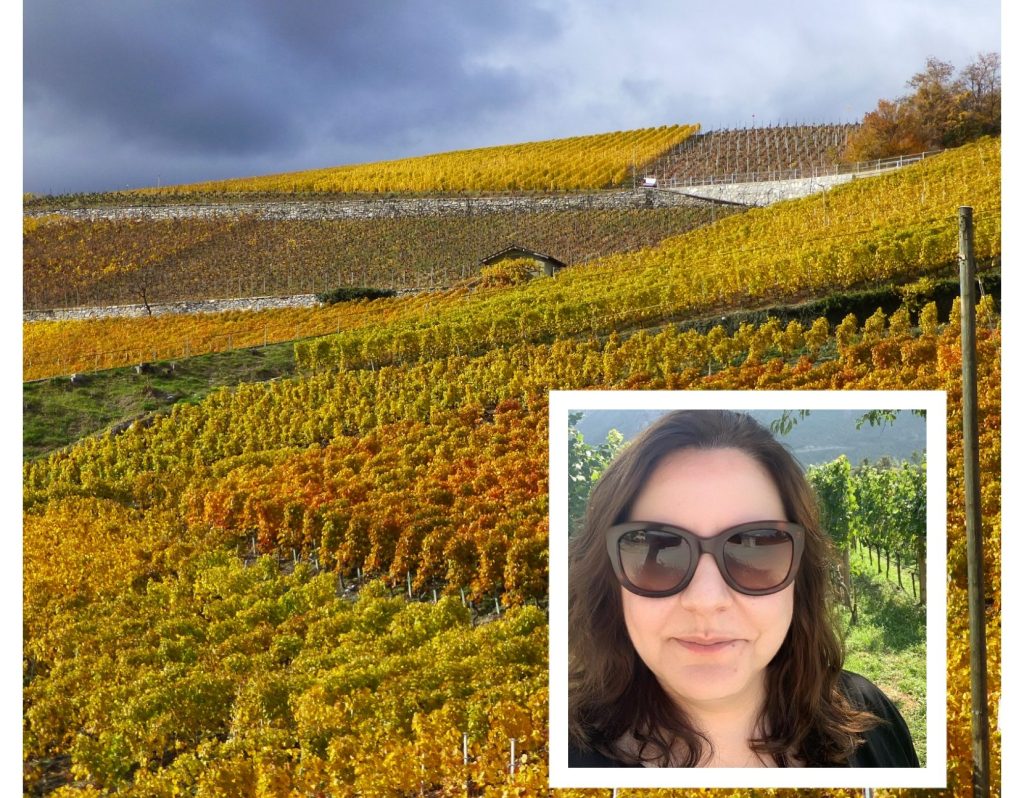
This is the story of an impromptu encounter. I met Célia Alves, a young pharmacist born in Portugal, lived in Brazil and moved to Basel a few years ago. A bubbly woman passionate about wine, meeting people and travelling. She recently discovered the wines of Valais. We talked during her visit to my family’s winery in Sierre (center of Valais). Discover her vision about Swiss wines and building bridges between Swiss and Portugal.
Célia, where do you come from? Your story is atypical!
– I am Portuguese by birth and roots, Brazilian by heart, and a lover of Switzerland. I am originally from Portugal, but my parents moved to Brazil when I was 6 years old (my mother‘s uncles lived there since the 60‘s), where I lived for over 20 years.
Why did you move to Basel in the first place? It’s not the most popular city in Switzerland.
– I moved to Basel because of my work. I work in Pharma and the company I worked for has the headquarters in Basel.
Tell me about your job Switzerland? Is it the same as in Brazil?
– I work in Pharma, helping developing new medicines. My work here is similar to my work in Brazil, but has a broader scope. Here I had the opportunity to work with other regions like Asia, Middle East, Africa, Europe and US, what give me friends all over the world.
Do you find some similarities between Portugal and Switzerland (landscapes, work, people…)? And some differences?
– Yes, a lot of similarities indeed, besides the usual neutrality of both countries.
Talking about Wallis, landscape wise, the vineyards area is very similar to the Douro region in Portugal, where the vineyards are also planted in terraces, in the hillsides. Weather wise, Wallis remembers the very hot and dry September days in Alentejo. Winter is another thing…People wise, both are humble, hard working, and generous people. Sometimes very serious at the first glance, but when you get to know them, they melt like butter. And both love to make and drink good wine and are great hosts.
Worth mentioning the indigenous grape varieties in both countries, that make Portuguese and Swiss wine from Valais unique and very special.
From my perspective, portuguese people are not always very confident on who they are and not always proud of their country, which has a somehow recent and long dictatorship history. The geographic location (the extreme west of Europe) is also a blessing and a curse, and it was always appealing to look outside the country and explore other lands (it includes my family and the experiences in Africa and Brazil). Switzerland is the opposite, it is nestled in the middle of Europe, and was somehow forced to look inside the country, understand its strengths and grow in it, which has paid off over time, building on tradition and adding innovation.
But I have to say it made me proud to see so many Portuguese families working here in the region, in the wine making. I think Wallis wine has a little bit of portuguese influence and soul.
Your language skills are impressive! How many of them do you speak?
– Thank you. I speak Portuguese with a Brazilian accent, Spanish, English and learning German. Shame on me my German is so bad, and that I don’t speak French.
Before going to Switzerland, did you already enjoy wine in Portugal?
– Yes, literally since a child. I am from Beira-Baixa, near Serra da Estrela, a rural area in the Portugal country side, where wine is produced since roman times (but not well known).
I am from a family of artisans and farmers who used to produce wine. For me the smell of the wine cellars brings me back to my childhood, to the memories with my grandparents, to my little village in Portugal, to the forest of pines trees I’ll always call home. Wine takes me home.
During your visit in Valais wineries, what was your first impression? Did the people welcomed you well?
– When I arrived, I thought that I was lost and was indeed in… Portugal. Wallis is a very special part of Switzerland, a little paradise. And people are very welcoming and friendly.
Did you like the wines? Do you have a special one you love and another one less?
– I loved the Wallis wines! Taste wise they are great, and it is also interesting to explore it for the uniqueness of the speciality / indigenous grapes here, a similarity with Portugal, also rich in speciality local varieties.
From the whites, my favourites are Petite Arvine, Humagne Blanche and Heida. From the reds, Humagne Rouge, Cornalin and Pinot Noir. And also impressed with the Shirah (Shiraz), which seems to be adapting well in Switzerland. But what really surprised me where the blends, for both white and reds. They are excellent, and no, not speaking about the ”dôle“, which is also good. Worth to mention the Pinot Noirs from the north of Switzerland. Those I have tried so far are of high quality as well. There is nothing that I didn’t like, but it all makes Chardonnay look boring.
You met the wine-makers… what did you think of their personality?
– Yes, I had the privilege to meet Mr Maurice Zufferey, Mr Adrien Zufferey, Mr Denis Mercier (by chance) and Mr Robert Taramarcaz. I saw a lot of knowledge, know-how, understanding of the land and the climate, hard work, passion for farming, passion for the environment, passion for winemaking, hope, respect for the tradition, innovation, entrepreneurship spirit, and it all translates in the world class wine produced here. They put their strong and humble character in their wines unapologetically, in a very elegant and individual way. Pure art.
What would you recommend to our wine-makers about promotion, hospitality or other?
– There are a lot of potential and options here, a lot to explore… Wine and walking, wine and hiking, wine and cycling, wine and cooking, wine and dining, wine and chilling, however some small hotels and restaurants in the vineyards would be welcome.
Swiss wine is unknown outside of Switzerland, despite its high quality and it deserves to be made known. But also in Switzerland, I am under the impression that the wine growing regions are not well know.
I would suggest focusing on some sort of promotional activities, for example organise few events with key wine influencers (specialised wine writers in key newspapers and magazines), maybe combining wine with other activities (nature, mountains, hiking, cycling, local cuisine). Create some combos and advertise them in collaboration with different tourism offices can also be an option.
Maybe a small documentary with some producers could help create awareness. These vineyards have such a rich story, over generations, that it deserves to be told. As an example, the tasting room at Cave Maurice Zufferey has so many stories to tell… How about written a book about that, Anaïs?
I think Wallis exceeds on its landscapes, mountains, vineyards, wines, cuisine, and hospitality. But not much of that is known besides the mountains, or besides Zermatt. Time to change that.
Would you come back in Valais one day? There are still a lot of cellars to visit!
– Definitely yes. I had only few days this time, and had to choose few wineries to visit (Domaine Rouvinez, Cave Maurice Zufferey, and Domaine des Muses) but I still have a long list of places to visit. Deeply sad I could not visit Cave Caloz and Mr Denis Mercier this time. I am very much looking forward to coming back soon.
It’s your turn to make some promotion for your home country: recommend us a Portugese wine (type of grape and cellar)?
– For the whites: Alvarinho from the Minho river Valley (Vinho Verde region) is a traditional white variety and Anselmo Mendes is a great representative of it.
Being a little provocative, some whites from Alentejo (mostly a red producer) are interesting, like Susana Esteban‘s Procura which is a blend of local Alentejo varieties, from an old vineyard located in the border between Alentejo and the “Beiras“ (yes, near home).
For the reds: Touriga nacional, from Douro, Dão and Alentejo regions. Some examples: Douro – Quinta do Crasto (aged in oak barrels); Dão – Álvaro Castro from the Serra da Estrela region (literally home), and Alentejo – Herdade do Esporão, and Herdade da Malhadinha Nova.
For desssert: Moscatel de Setúbal, eg Alambre 20 years by José Maria da Fonseca. And the tradicional Port and Madeira.
Do you have a question that I didn’t ask that you want to answer?
– I think the best time to come to Wallis for wine purposes is the autumn. Mild temperatures, and the autumn colours combined with the local wines are the perfect combination. I am dreaming of that right now.
To finish this interview, can you tell me how to say “Santé!” in brazilian Portugese and in Portugese?
– Tim-Tim! and Saúde! are used in Brazil and Portugal. So, Saúde !
Thank you for answering my questions, I wish you all the best for the future!
-Merci à toi!
About: Discover the blog and the Instagram page of Célia Alves.
 Anaïs Zufferey
Laisser un commentaire